


Periodization goes by a lot of different names. You’ll hear many people in the fitness or strength and conditioning industry often discuss training splits, plans, outlines, cycles, templates, or programming (nothing to do with computers in this case). Whatever you choose to call it, all of these terms really refer to some kind of underlying structure, which is the fundamental component of periodization.
Since it’s such a broad topic (and to keep things simple), periodization can be defined solely as the organization of training. The layout of your training session, your training week, and even your training over an entire year or more is classified as periodization. Of course, this opens the door for many different combinations of means, each with much more specific details and definitions. This is important to realize up front for a couple reasons:
- There is more than one way to the pot of training goals at the end of the rainbow.
- All efficient periodization strategies share the common denominator of checking all the mandatory conceptual boxes, which don’t include hype, outrageous claims, or sex appeal.
At the end of the day, there is good evidence showing that any kind of periodization is more effective at attaining results than no periodization, so whichever path you go, make sure to stick to it with a purpose, lest you become someone who aimlessly wanders around the gym, doing off-the-cuff randomized workouts.
Perhaps it’s easier to put it this way: if you choose that you just want to exercise the rest of your life with no real goals or results to show (maybe so you can assure yourself and/or your doctor that you work out and feel good about it), aimless and random may suffice for you. But as soon as you begin to set clear goals and subsequently start to map out the course to get to them via logical training progression, you need to understand periodization.
Some Brief Definitions…
Before I get into the thick of things, let me introduce some terminology that I’ll be using to describe periodization within different timespans:
- microcycle – the period of training in which all different training sessions are completed but not repeated. 9 times out of 10 this refers to a week of training (which is how I’ll mostly refer to it)
- mesocycle – a period of microcycles grouped together, usually in a month or “block.” A mesocycle is usually 3-6 weeks in length and different mesocycles are often separated by a deloading period.
- macrocycle – a period of consecutive mesocycles. This can span an entire year or more, or for those who compete in any capacity, it usually refers to the entire course of training leading up to competition (anywhere from 9-24 weeks depending on level of advancement).
Path of a Trainee
I think that it would be most effective to write this post as a sort of narrative, chronologically outlining the general course one should take from the starting point of training all the way into the advanced stage.
Not only do I believe this progression to be logical, but also optimal for avoiding unnecessary injuries, setbacks, or the feared general wasting of time. I’ll start with the simplest form of periodization that also serves as the starting line: linear progression.
Linear Progression
Linear progression is the perhaps the oldest form of periodization and the easiest to follow. It simply requires adding intensity from session to session until you can no longer do so. This is most often followed by those beginning strength training, in which the trainee adds weight to the bar every single time he or she completes a given exercise.
Notice how there is no mention of adding training volume or frequency yet. If you’re an absolute beginner, there is no need to start changing more than one variable at a time. Simplicity is on your side here, so take advantage of it.
The scope of training during a linear progression is focused only workout to workout. This is because in the beginning stages of training, you only need a small stimulus to progress, therefore the stimulus/recovery/adaptation (SRA) cycle for a given exercise or muscle group takes place within a small window of time; probably around 48 hours for most. For this reason, it’s advisable to keep a linear progression around 2-3 days/week, in which a full microcycle is one week in length.
Here’s an example of what a linear progression might look like over a 2-week span:
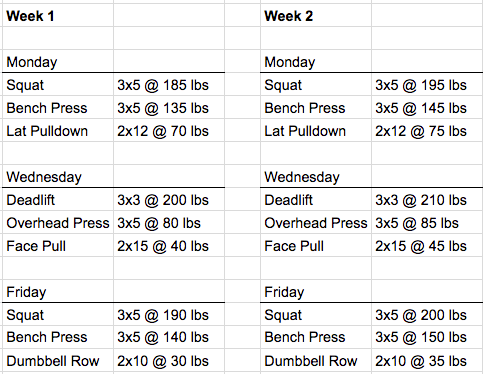
Remember, the name of the game here is simplicity. You’re able to get by making progress in the simplest way possible and you should milk it out that way as long as you can. Think of it as getting the best possible return on the minimal amount of investment. That isn’t to say that linear progression can’t get difficult, because things can get damn hard as you’re approaching the end. In my experience, most people can run a successful linear progression for at least 2-3 months, although I’ve seen people closer to the far right of the bell curve go much longer before stalling out.
The nature of a linear progression also means that there are no true microcycles, mesocycles, or macrocycles designed ahead of time. Imagine it instead as one continuous walk up a moderately steep hill until you reach the point where the incline levels off.
Towards the end of your linear progression, there are some tools you can use like resets, rep drops, and down sets in order to try to prolong those wonderfully simple gains. However, at some point you will begin to spin your wheels, regardless of any tricks in the book you keep throwing in. When this day comes, it’s time to start introducing undulation.
Undulation
Undulation, by definition, is flowing, up-and-down, wave-like movement. In the periodization sense, it refers to organizing training sessions in a way in which volume and intensity change workout to workout. Because of this structure, these training variables are “waved” over the course of a microcycle, then recycled, hence the name “undulating periodization.” The reason for making such a change boils down to the SRA cycle again.
During linear progression, you can introduce greater stress on a daily basis because the SRA cycle runs its course over an accordingly short span of time. Once you can no longer introduce sufficient stress on a daily basis to progress, the need to accumulate stress becomes present. In this case, you’re focusing on the total amount of stress produced across a microcycle, not any given day within the week.
Due to realistic recovery constraints at this point, we can no longer make every workout of the week a max effort performance. This is where the beauty of undulation comes in. By designating certain sessions ahead of time to be higher or lower in total workload/stress, you can still achieve your goal stimulus at the end of each microcycle without regressing, getting injured, or throwing up your hands and accepting that you’ve already hit your genetic limit.
In my experience, the easiest way to begin to set this up is what I call a classic “heavy-light-medium” split. In this setup, you can still stick with the 3x/microcycle training frequency from your linear progression, only one day is designated to be the most stressful session, the second day the least stressful, and the third day somewhere in between.
When most people look into this kind of periodization, they are always quick to question whether stress should be manipulated via volume or intensity. To keep it simple, I say use a combination of both starting out.
Here’s an example of how you could set up a weekly split as such:
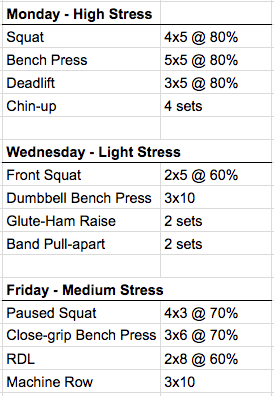
As you get a little further into undulating periodization, you can even get more specific and use a heavy-light-medium organization for certain exercises within each workout. For example, one given day might include a heavy squatting variation, a light pressing variation, and a medium pulling or rowing variation. In this case, this day would also likely serve as your high or moderate stress day of the microcycle.
Trekking even further into undulating periodization will eventually lead you into not only undulating training sessions across microcycles, but undulating microcycles as well. As an example, you may see this commonly written into programs simply as “A, B, and C weeks,” in which the entire microcycles themselves are designed to produce specific amounts of cumulative training stress.
The thing is, once you get far enough down the undulating road, it inevitably means that the SRA cycle will lengthen once again. The next logical step in the process is to start looking at training from mesocycle to mesocycle, a perspective commonly attributed to block periodization.
Basic Block
As I just alluded to, you could replace the term “block” with “mesocycle” and easily have an idea of how block periodization is structured. Again, think of zooming out your training lens to where the most significant changes are seen from a mesocycle to mesocycle (often month to month) view at the smallest. In fact, for those very advanced individuals, measurable progress may only be seen macrocycle to macrocycle (think Michael Phelps training for a year to shave a few seconds off a couple of his events).
There are many different options for how to design a long-term block training program, but for the sake of simplicity, I’ll lay out the chronological sequence that should be followed in general, especially by those just embarking into block territory.
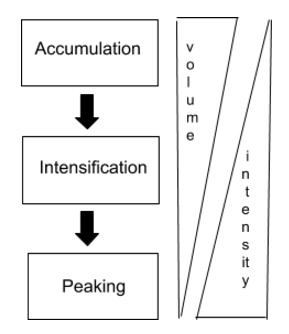
The first mesocycle commonly followed is known as an accumulation block. In this case, accumulation refers to the process of accumulating stress by progressively adding training volume, which is exactly the goal of this block. In the first week/microcycle, training volume should start out moderate and then gradually increase with each subsequent microcycle, eventually hitting its peak in the 4th or 5th microcycle before deloading for a microcycle. Altogether, this mesocycle of training should be low to moderate in intensity and moderate to high volume.
After an accumulation block (and deload in most cases), the next step is to transition into a transmutation phase, often just referred to as an intensification block. As the latter name implies, the purpose of this mesocycle is to ramp up intensity while slightly dropping volume. Compared to the prior accumulation block, this mesocycle should be lower in volume and relatively higher in intensity.
The last phase of training in a block program is called a peaking block. In older texts, this period is commonly called a realization block, as the goal here is to manipulate training variables so that you may eventually express your peak performance, thus “realizing” the end results of your prior training. A peaking block starts with rather high intensities at moderate volumes, then holds intensity somewhat high while gradually dropping volume. The purpose of this strategy is to shed excessive fatigue that has accumulated from consistent applications of training stress, so that an enhanced physical capacity can be experienced at the end. The most common example of this is athletes tapering down their intense training as they approach a competition. Much of a peaking block is, by definition, a taper and serves the same purpose.
At the end of a peaking block, hopefully you’ve come away with some personal bests. I’ve found that at this point, it might be a good idea for some trainees to not only deload, but move back into a shorter preparatory block, in which volume and intensity are fairly moderate. This serves to gradually build back up from the extremely low volumes at the end of your peaking block to the much higher volumes of the next accumulation block. Think of this as taking a short amount of time to get acclimated again before jumping back in headfirst.
Here’s a simple visual of how a basic block routine looks (minus the optional preparatory block):
Other Considerations
Aside from the changing of training stress models as you become more advanced, it’s also important to discuss the need for certain variation within training. For instance, you don’t need to be doing scores of exercises during your linear progression, because your progression is a day-to-day process. How will you be able to objectively evaluate progress on that basis if you are changing exercises every single workout? You could make much more progress at a faster rate just by getting better at the basics until things begin to slow.
Conversely, increased variation may be a necessity by the time you work your way up to advanced block programming, since you are concerned with a lot more macroscopic level of stress, and continually increasing volume or intensity with the same exercises is probably not a long-term reality by this time.
I’ll sum it up this way: during a linear progression, maybe the only lower body strength parameter you track is what you can squat for 3 sets of 5. By the time you become advanced however, your parameters may not only include your 3×5 squat, but also your 3×5 front squat, 6RM RDL, 4×3 paused squat, etc. At this point, it’s also very possible that you may only test these parameters once per mesocycle, instead of multiple times a week like you would in a linear progression.
It’s also advisable to increase training frequency once you hit a more advanced stage, perhaps when you start block training. Not only is it a simple way to add the effective volume you need, but it also keeps workouts from building up to 2 hours or more in duration. I’ve personally never written anything higher than 5x/week for anyone, as I just haven’t seen the risk/reward ratio to be optimal for most folks in that case. After all, you can’t train effectively if you’re hurt all the time and/or psychologically burnt out.
Possible Combinations
Keep in mind that what I’ve laid out in this post is only a guide with general explanations. Many of these variables can be blended with one another over different courses of time. For example, much of my own training has a block-style setup with both daily and weekly undulation and an overall linear approach over the course of each block.
Again, like most things training-related, always focus on checking off the essentials rather than adhering to a rigid system that doesn’t address them. Have the patience and presence of mind to find what is and isn’t working.
If you have questions about more of the in-depth details of this stuff, or if you’d like to know where to find some other great resources on periodization, please don’t hesitate to reach out.
B.S., Belief & Sustainability
Overall, you should have utmost confidence in whatever program you choose to follow. I observe so many people in this industry seeing who can yell the loudest when they’re all really selling the same thing. Be keen to bullshit and understand why certain programs would logically work and why others seem to good to be true with no real intelligent explanation.
That being said, belief is a powerful tool, and the way in which your training is set up should only build your belief in it over time. Having that kind of belief will likely never make sustainability a problem, and though it might be cliche’, you know that in many cases, the most effective program is the one that you’ll stick to.
Recap
- Some kind of periodization is better than no kind of periodization.
- The most efficient way for beginners to start is with simple linear progression.
- To optimally present longer-term training stress, introduce undulation.
- To compensate for needing even longer periods of accumulated training stress, shift to some variation of a block-style program.
- No matter what your program looks like, make sure it checks all the mandatory boxes and fits together logically.

Feel free to comment with any questions or thoughts; you can also contact me directly at strengthscrolls@gmail.com
Thanks for reading!
 Strength Scrolls